Wood-Look PVC Cladding, Soffit and Decking: A Contractor's Buying Guide
For a contractor, an exterior board is judged on four things: how fast it goes up, how clean it cuts and finishes, whether it brings you back for a callback, and whether it is on the shelf when the job is ready. This guide covers each one for ASA-capped PVC wall cladding, soffit and porch ceilings, and decking, with the specs, the layout rule that matters most and how supply and trade pricing work. It is written by YJJNANO, the manufacturer, and it says plainly where the board has limits.
Install time is where the money is
CladdiWood wall panels and SoffiWood ceiling boards are tongue and groove. They go up with ordinary flat-head self-tapping screws, no pre-drilling: the screw goes through the tongue and the next board covers it, so there are no visible fasteners and nothing to fill.
The boards come off the pallet straight. On a wood ceiling you spend time pressing and forcing each board to lock because wood is never quite straight; these lock in without fighting them. There is no sanding, staining or touch-up afterwards, which on a porch ceiling or soffit is the part of the job nobody wants to be on a ladder for.
Contractors who have installed it rarely go back to what they used before. A full install video is on our resources page.
Cutting, trim and finishing
Any mitre saw works. Use a fine-tooth finishing blade, 60 teeth or more, and it cuts clean without chipping. Installers coming from metal cladding notice the difference straight away.
L trim handles outside corners and window and door surrounds; it comes in 12 ft lengths, 1.8 in by 1.8 in. Colour-matched finishing strips are available too. Brad nails are fine for the trim and end pieces; the panels themselves take screws. Where a board ends at a beam or wall you can butt it in or close it with L trim, and some crews finish with black aluminium flashing instead, which looks sharp and costs less.
Mitres hold. A 12 ft board moves about 3 mm over a 40°C swing, so a 45° corner stays tight.
The one layout rule: no butt joints on siding
A wall in full sun moves through big temperature swings every day. A 12 ft board moves about 3 mm over a 40°C swing: small, but a butt joint is exactly where you would see it open and close. So on siding, plan the layout so there are no board-to-board butt joints at all.
The simplest way is to run the boards vertically. Few walls are taller than 12 ft, so one board covers the full height. Horizontal works well on smaller structures such as sheds, pergolas and cabanas, where each run fits in one piece. If a wall run is longer than 12 ft, change direction or add a vertical trim line rather than leaving a row of joints in the sun.
Ceilings are more forgiving because they sit in shade, but the same habits make for a cleaner job.
Soffits, porch ceilings and under-deck ceilings
Ceilings are more than half of what we sell, under decks and on porches, cabanas and eaves. For a vented soffit we do not make a perforated board; the cleaner detail is a continuous vent strip between panels, stocked at Home Depot and Home Hardware, which reads as one thin black line.
Be clear with the client about water under a deck. The boards are waterproof but a board ceiling is not a roof: water gets through the joints. If they want a dry space underneath, a drainage system goes in above the ceiling first, and our boards are the finished ceiling below it.
Decking
DeckiWood is a solid (not hollow) board, 1 in thick and 5.5 in wide, in 16 ft grooved and 17 ft non-grooved lengths. It fastens with our own hidden YJJNANO clips, which come with the boards, so there is nothing extra to source. The boards are double-sided with a different colour on each face: if one face gets damaged, flip the board.
Callbacks: fading, swelling and mould
The jobs that bring you back are the ones that fade unevenly on the south wall, swell at the joints or grow mould on the shaded side. The outer layer is ASA, which holds its colour in sun, and the core is foam PVC with no wood flour to take on water. The 15-year warranty covers colour fading, held to less than Delta E 5, not just cracking, and the warranty document is ready to hand to the client.
On permits: cladding an existing wall normally needs none; attaching a new structure, such as a patio cover, usually does.
Supply: stock, pickup, delivery and quantities
Everything is stocked in Markham in six colours: Charcoal, Walnut, Golden Teak, Textured Teak, Cocobolo and White. Wall and ceiling boards come in 8 ft and 12 ft lengths. Boards are sold by the piece with no minimum, so you buy what the job needs.
Pickup in Markham is free; give us a day's notice so the order is pulled. Delivery is priced by location and size. If the order is ready it can go on a truck the same day, and the GTA is usually next day. Custom lengths are possible with a minimum of 3,000 sq ft (one pallet), lead time and payment up front.
For take-offs, work on 5.906 in of coverage per board, not 6 in: an 8 ft board covers 3.94 sq ft and a 12 ft board 5.9 sq ft. Add the corners and every window and door for L trim. Full-length, uncut leftovers can come back within 30 days under our return policy.
Trade pricing and samples
There is a tiered trade program. Send us your company name or business card and we set you up and quote the job at your rate. Contractors and builders get a full sample box rather than single chips, so you can show clients every colour. Companies that want to stock and resell the boards can apply through the dealer program.
Specs at a glance
| CladdiWood wall / SoffiWood ceiling | DeckiWood® decking | |
|---|---|---|
| Material | Foam-core PVC with an ASA cap | PVC with an ASA cap, solid (not hollow) |
| Size | 6 in wide (5.906 in coverage), 15 mm thick | 5.5 in wide, 1 in thick |
| Lengths | 8 ft and 12 ft | 16 ft grooved, 17 ft non-grooved |
| Coverage per board | 8 ft: 3.94 sq ft. 12 ft: 5.9 sq ft | By deck layout |
| Profile | Tongue and groove, screws hidden by the next board | Double-sided, a different colour on each face |
| Fastening | Flat-head self-tapping screws, no pre-drilling | Hidden YJJNANO clips, supplied with the boards |
| Cutting | Any mitre saw, fine-tooth blade, 60T or more | Any mitre saw, fine-tooth blade, 60T or more |
| Trim | L trim 12 ft, 1.8 x 1.8 in; colour-matched finishing strips | — |
| Movement | About 3 mm per 12 ft over a 40°C swing | — |
| Warranty | 15 years, including colour fading (Delta E < 5) | 15 years, including colour fading (Delta E < 5) |
| Stock | Six colours in Markham, sold by the piece | In Markham, sold by the piece |
Jobs done with these boards
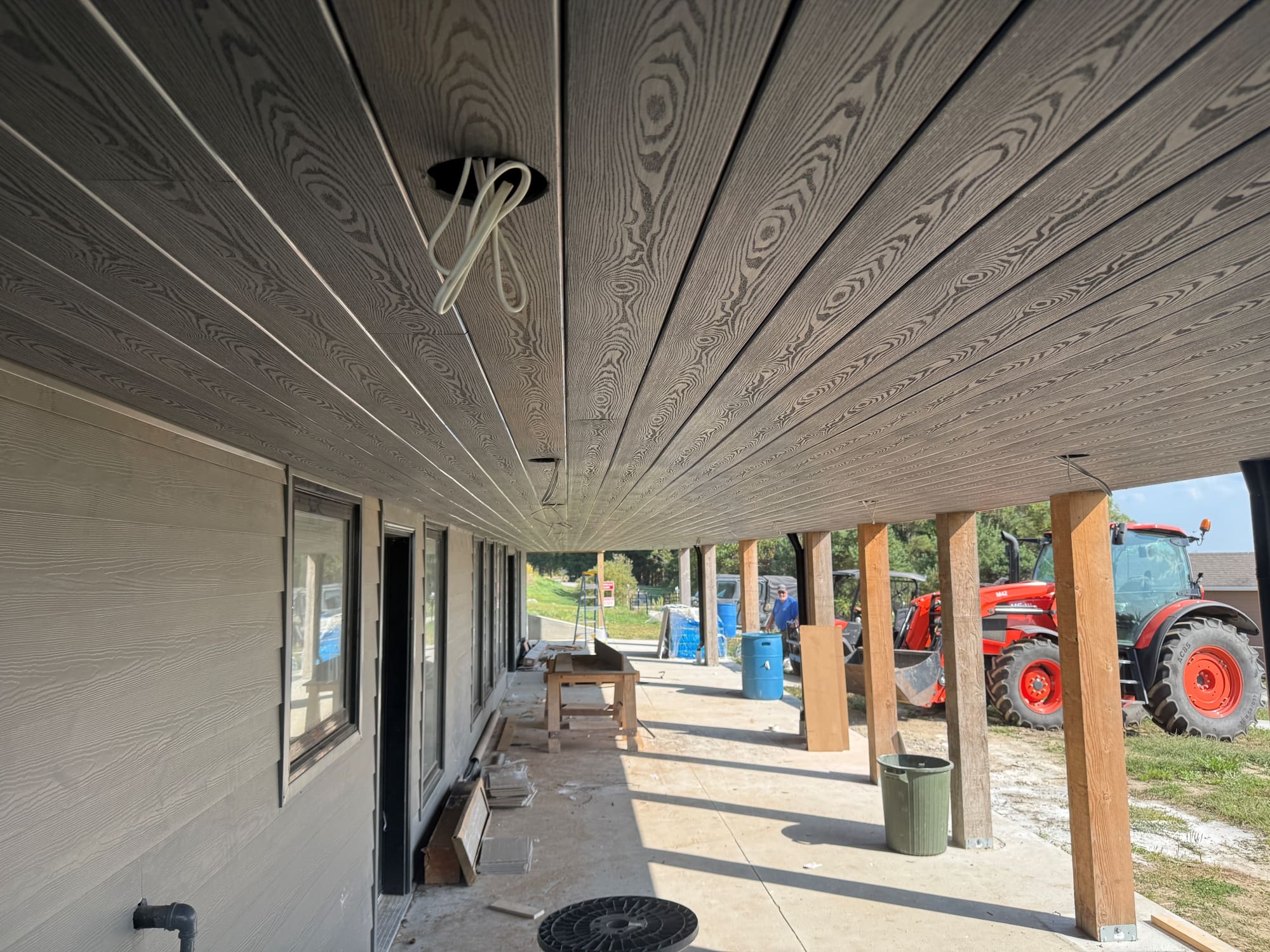
- Under a raised wraparound deck — Oshawa, ON, Charcoal
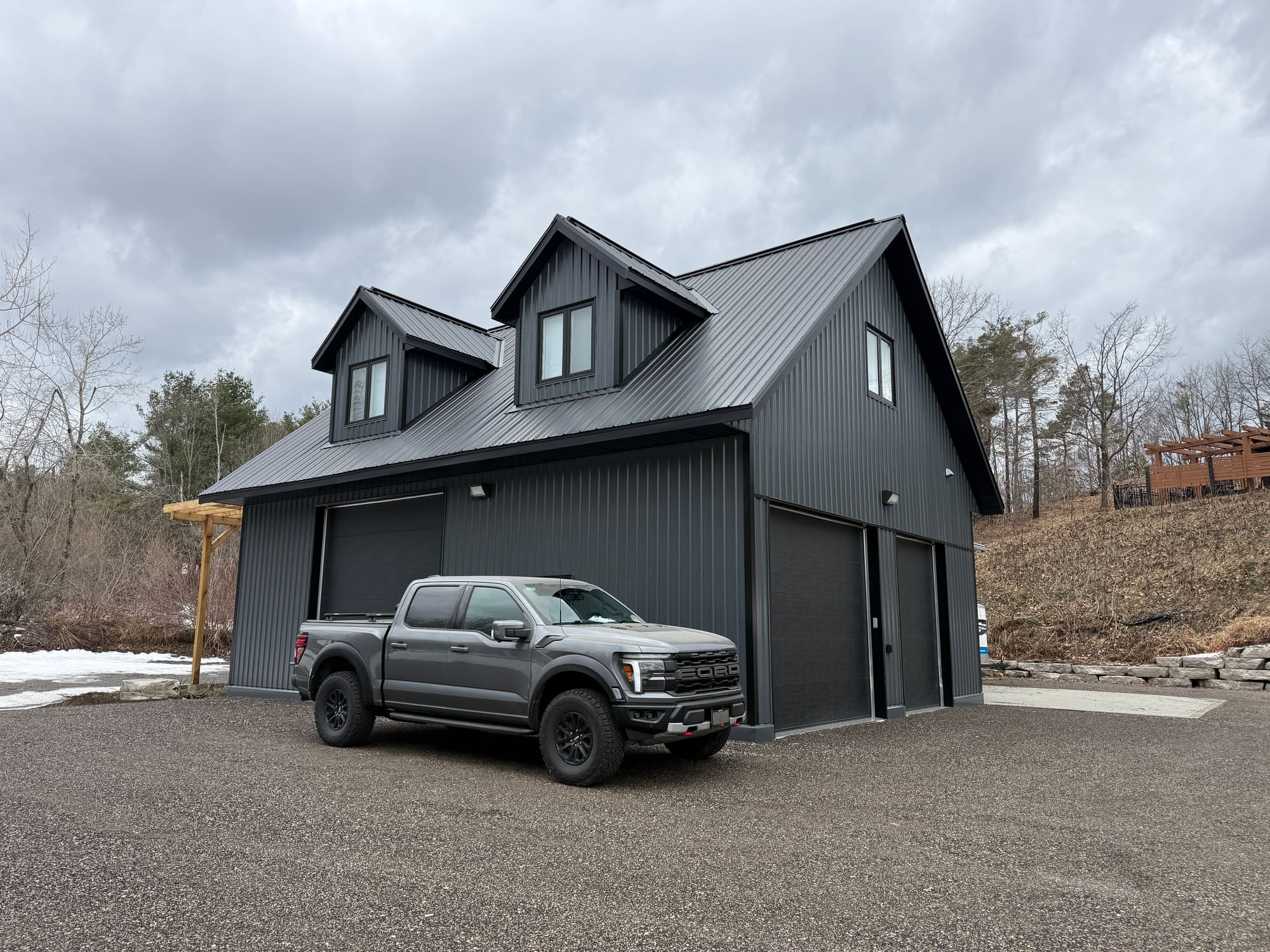
- Wall cladding — Barrie, ON, Charcoal
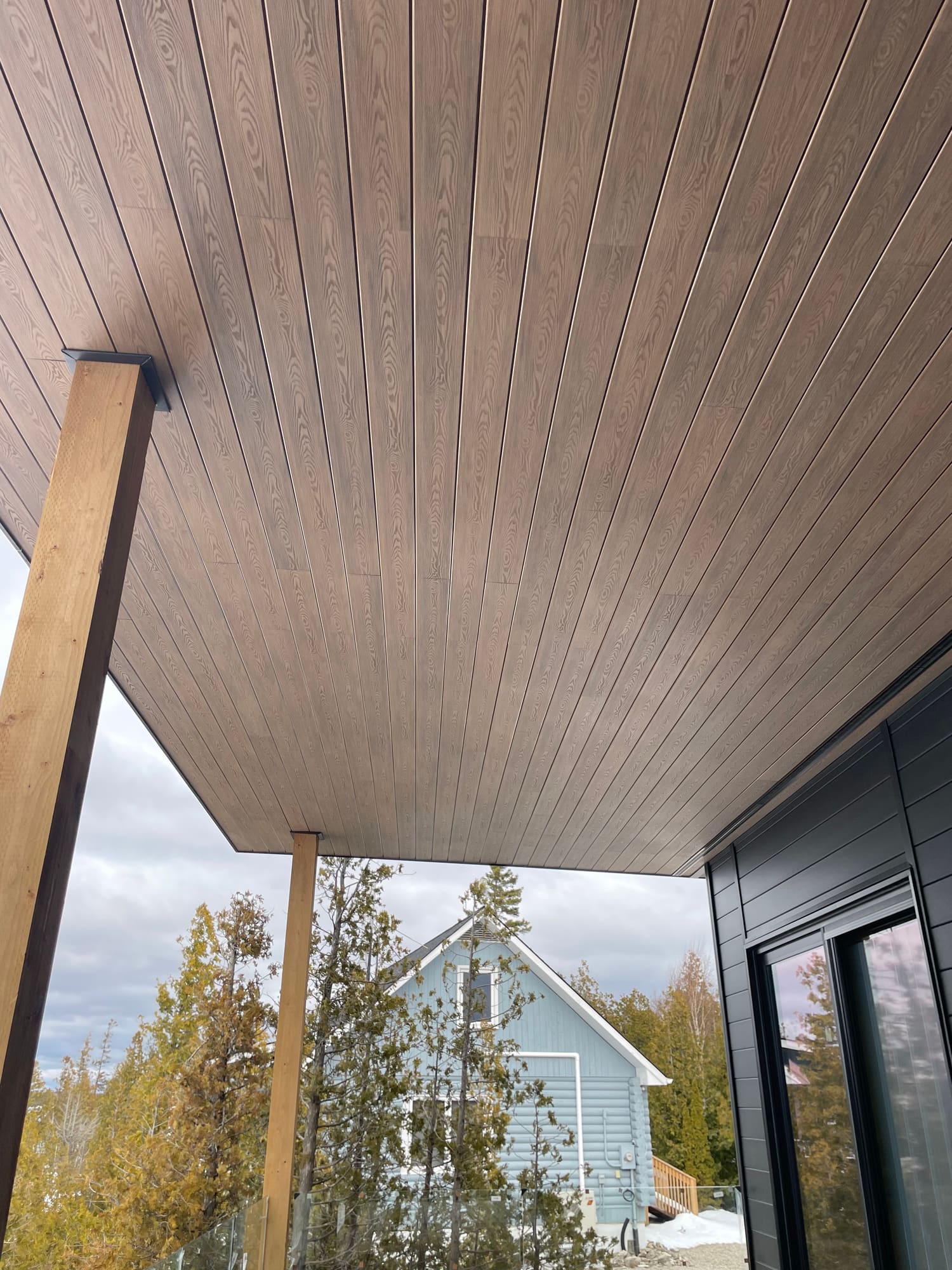
- Wraparound porch and eaves — Sauble Beach, ON, Walnut
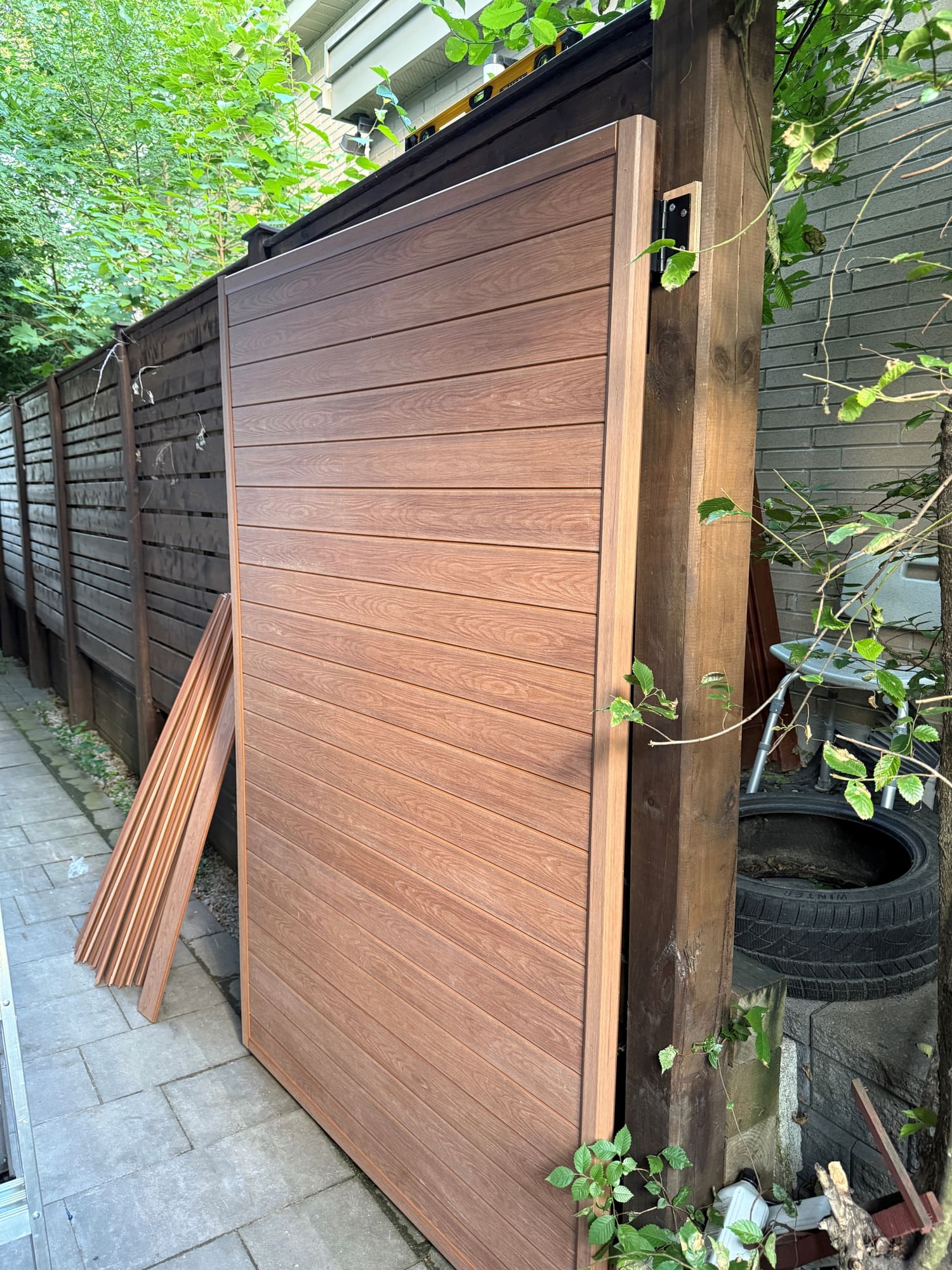
- Wall cladding — York Mills, ON, Textured Teak
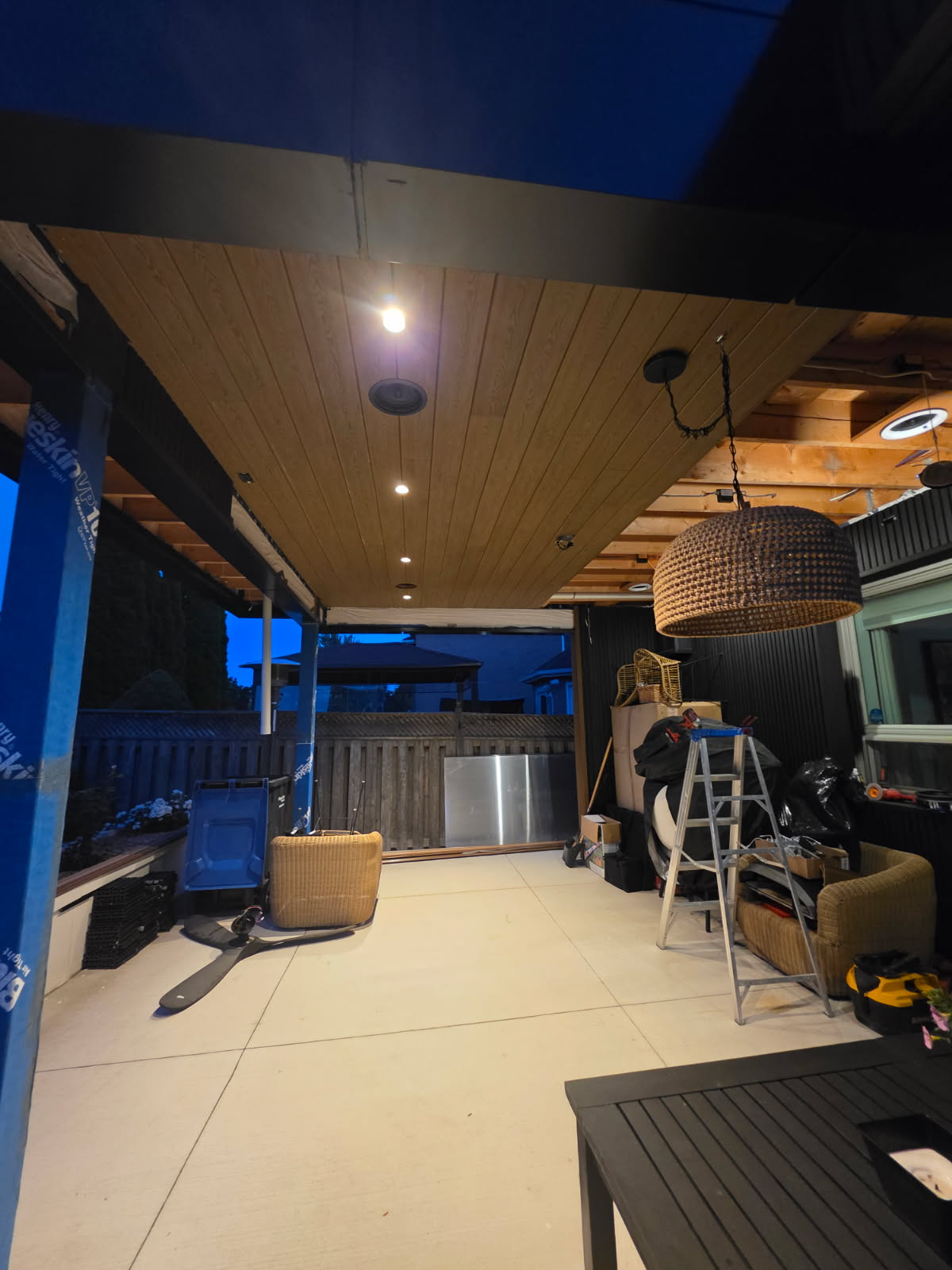
- Covered patio, with pot lights — Mississauga, ON, Golden Teak
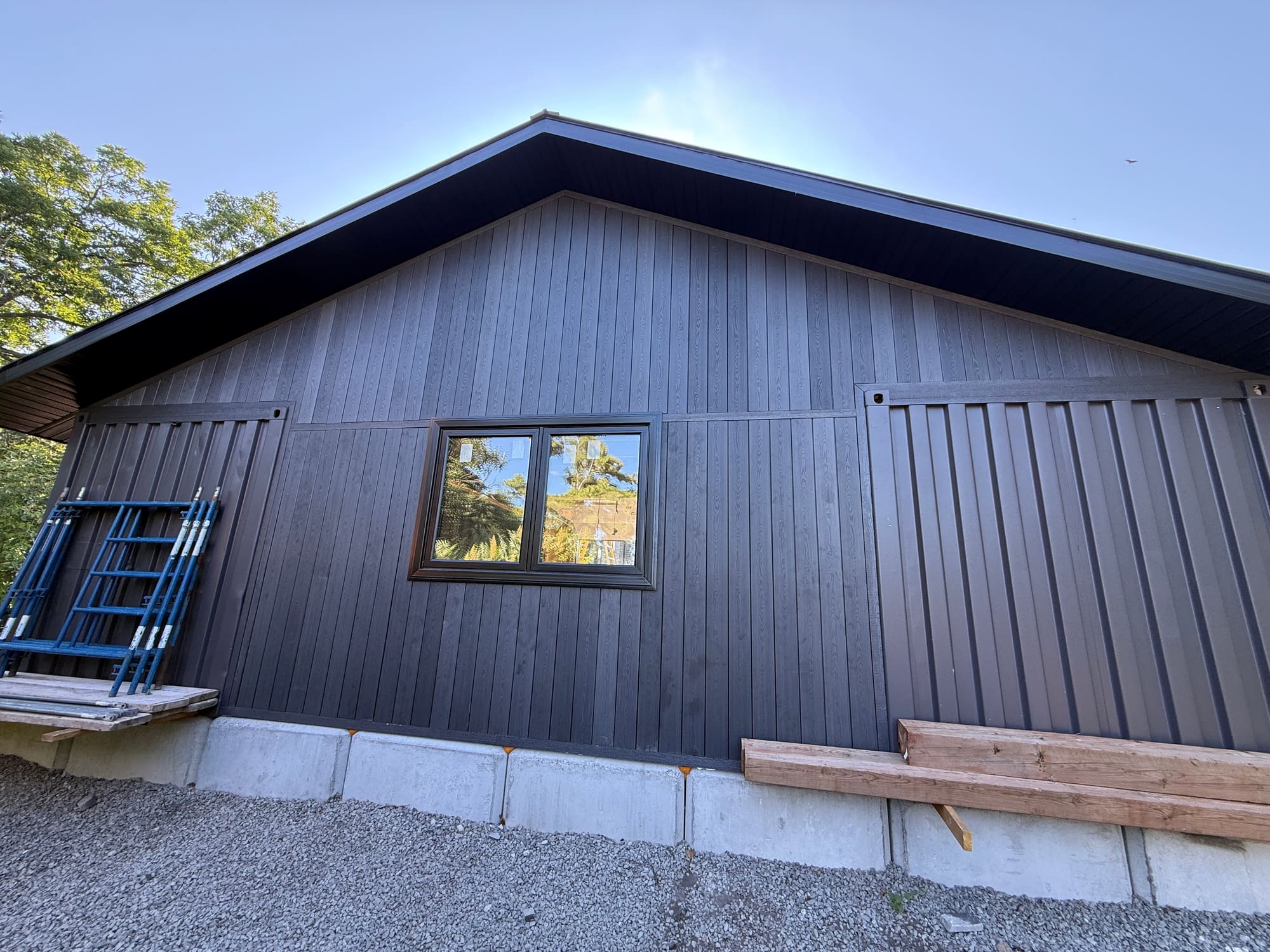
- Wall cladding — Honey Harbour, ON, Charcoal
Common questions
Do I need special tools?
No. Any mitre saw with a fine-tooth finishing blade, 60 teeth or more, a drill driver for the screws and a brad nailer for the trim.
Do I have to pre-drill?
No. Flat-head self-tapping screws go straight through the tongue, and the next board covers them.
Are clips or fasteners included?
For DeckiWood decking, yes: our hidden YJJNANO clips come with the boards. Wall and ceiling boards use ordinary flat-head self-tapping screws.
Can siding run horizontally?
Yes, on smaller structures where each run fits in one board. On a house wall, vertical is the better layout because one 12 ft board covers the full height with no butt joints.
What do I do on a wall longer than 12 ft?
Avoid a row of butt joints in the sun. Change direction or add a vertical trim line. Custom lengths are possible, but the minimum is 3,000 sq ft with lead time.
How much does it move?
About 3 mm over a 12 ft board with a 40°C temperature swing.
Can I mitre the corners?
Yes. The movement is small enough that a 45° mitre holds. L trim is the alternative for outside corners.
Is there a vented soffit board?
No perforated board. Use a continuous vent strip between panels; it is stocked at Home Depot and Home Hardware and details cleanly with our boards.
How quickly can I get material?
It is stocked in Markham. Pickup is free with a day's notice. A ready order can go on a truck the same day, and the GTA is usually next day.
Do you have contractor pricing?
Yes, a tiered trade program. Send us your company name or card and we will quote the job at your rate.
Can I get samples for clients?
Yes. Contractors and builders get a full sample box. Pick it up in Markham or we can mail it.
What if I over-order?
Full-length, uncut boards can come back within 30 days: a 20% restocking fee for a refund, or 10% if you take store credit. Most crews keep a few boards for small jobs later.
Third-party references
- Wikipedia — Acrylonitrile styrene acrylate (ASA): weathering and UV resistance
- Plastics Technology — Wood-Plastic Composites: Weathering Quality Issues
- Construction and Building Materials — Impact of high moisture conditions on the serviceability of WPC decks
- Trex — RainEscape under-deck drainage system
Related guides
- Become a dealer or set up a trade account
- The ventilation detail: a soffit vent as one black line
- Under-deck ceilings: drainage options and the water question
- ASA/PVC vs WPC cladding: what actually differs on a wall
- Installation guides, warranty and spec sheets
- For your clients: the homeowner's buying guide
- Return policy
See CladdiWood · Request a quote
YJJNANO Materials Canada Inc.Phone: 289-512-9895
Email: [email protected]
Warehouse: 200 Telson Rd, Markham, ON L3R 1E6, Canada
Serving: Greater Toronto Area, Ontario, and across Canada